Wikipedia

Search results

01 July, 2016


After a lengthy tease from AMD we are finally seeing the new AMD Radeon RX 480 roll out. As we saw in our preview the card successfully makes leaps in its power to performance profile and brings a healthy performance jump to the mainstream market. It goes without saying that there will be custom cards coming from other vendors.

ASUS is the first to throw their hat into the ring with their new ROG Strix RX 480. This card will of course feature AMD’s new Polaris 10 core which brings us performance improvements with less power and heat. The ROG Strix RX 480 will also be an 8GB card running at 8GHz on the cards 256-bit bus, though ASUS has not yet released clock speeds for the GPU core.

The new card will be housed in ASUS’s DirectCU III cooler which will allow more performance and less noise. Around back the card will have a back plate. With both the back plate and the black metal shroud featuring Asus’s new Aura RGB lighting which will be helpful in color matching the card to a wide variety of builds.

ASUS is first to the punch with their custom cards, but many are sure to follow with the new release of the AMD Radeon RX 480. We’ll be sure to report on them as announcements come in.


THE WORLDS BEST AFFORDABLE GAMING LAPTOP

Asus ROG GL552VW laptop review


NEW DELHI: Asus has stirred the PC gaming market ever since it unleashed the ROG or Republic of Gamers laptop series. These powerful gaming machines over the years have not only witnessed improvement under-the-hood but have also been enhanced overall to deliver top-notch experience for gamers as well as non-gaming heavy users.

The Taiwanese-based tech company recently launched its ROG GL552VW gaming laptop priced at Rs 82,490. Being one of the newest in the line up, the laptop packs all the possible features one can expect from a high-end laptop. We spent few days with the Asus ROG GL552VW, playing some graphic-intensive video games along with some heavy software and endless hours of content streaming.
So, does the new gaming laptop makes the cut and is worthy enough for the gaming PC market? Read our review to find out.


Design and display

If you are familiar with gaming laptops, then Asus ROG GL552VW's 15.6-inch display and a spread-out full-size keyboard is something you would've already expected. It measures 385 x 255 x 32.4 mm and is available in two different finishes -- grey metal and black coloured model with plastic chassis. Our review unit was the one with metallic finish, which mixed well with the company's iconic Red and Black colour combination seen on the keyboard, exhaust grilles and the glowing company logo at the back.

Just like any other gaming laptop in the price segment, the ROG GL552VW too is heavy as it weighs almost 2.5kg. This makes it difficult to carry around. The display is tightly fitted with the rest of the body via two hinges. This definitely marks a plus point given that most large-screen laptops these days have displays that wobble even while typing.

READ ALSO:
HP launches world's thinnest laptop Spectre in India


The keyboard is a complete delight to use. The keys look amazing in Red backlit colour and are clickable just like any other regular keyboard. You can also control the intensity of the keyboard's backlight. Asus claims the model to feature 'perfect-response 1.8mm travel distance'. The arrow keys are big and are spaced out perfectly. Catering to the needs of gamers, Asus has also especially highlighted the WASD keys. The touchpad is large and is responsive.

There are two front-firing speakers placed above the keyboard area resulting in a more immersive experience while watching videos or playing video games. They are powered by the company's native SonicMaster technology.
On the sides, users get 2 USB 3.0 and a USB 2.0 ports, LAN port, HDMI, and audio/mic inputs. While there is an optical disk drive on one side, the other side includes heat vents. One of the pros of the Asus ROG GL552VW is that the battery is not enclosed inside the laptop as it can be unlocked using the spring heads. Asus has made it easy for gamers to upgrade the laptop by letting them easily access the RAM and harddrive as well.


There is a HD webcam, a 3-in-1 SD card reader and a USB Type-C (USB 3.1) too. The webcam was just about average. It can shoot images in HD resolution and can record HD videos in 15fps and 30fps options.

The ROG GL552VW's 15.6-inch full HD display is crisp and offers impressive 178 degree viewing angles. The colour shift on the display is also minimal while viewing it from sides. The matte screen manages to prevent reflection. However, for some reason when we got our review unit, the display unnaturally showed a warm yellowish tint. But a bit of screen calibration did the trick. We personally liked the inclusion of full HD resolution display because not only is it easy on the laptop's battery but also we don't really see a need for a UHD resolution display on a 15.6-inch display just yet. Both full HD and UHD resolution on a 15.6-inch screen hardly appear different. Of course on larger screens like TV sets it would make a big difference.

Performance

Asus ROG GL552VW stays on top of the game when it comes to performance. The laptops packs a powerful Intel Core i7 (6th Gen.) processor under-the-hood clubbed with 16GB of DDR4 SDRAM. Although our review unit features 16GB RAM, it can be expanded up to 32GB via dedicated RAM sockets. There is an 8GB RAM variant as well, but who would want that?

We played games like Assassin's Creed Syndicate, Mortal Kombat X (in multiplayer mode) among few others and as expected there was not a single glitch or lag. In some rare cases, playing few titles on 'Ultra' mode resulted in screen stutter but that is negligible. We saw some frames stuttering even when the ROG GL552VW was running on battery.


Gaming, both singleplayer and multiplayer via LAN was smooth. According to Asus, the laptop boasts Gamefirst III technology to enhance gameplay. Talking about graphics, the particular department is run by Intel's HD Graphics 530 GPU in tandem with NVIDIA GeForce GTX 960M, which although is not the latest in the market but does give you a decent performance. The Nvidia GPU comes with 4GB GDDR5 VRAM.

READ ALSO:
iBall CompBook Excelance review: As cheap as it gets

As for the storage, our Asus ROG GL552VW unit came with 1TB of inbuilt space, of which almost 900GB is user accessible. The laptop comes in two storage options -- 1TB with 7200RPM and 1TB with 128 GB SSD. The wireless connectivity reception was powerful and worked just fine. The gaming device supports Wi-Fi, Wi-Fi Direct, and Bluetooth v4.0 connectivity.

The software prowess of the Asus ROG GL552VW lies with Microsoft's latest Windows operating system, the Windows 10 (Windows 10 Home version). As one would expect, the OS comes with its own share of goodies such as the new start button, Cortana virtual reality assistant, Microsoft Edge, new Photos app and more.

Of course Asus has bundled other softwares too like Steam application, ROG Gaming Centre, Asus Web Storage, WPS Office and more. AudioWizard for customizing sound profiles, McAfee LiveSafe, Microsoft Office 365 (1-month trial pack), and Dropbox are also present.
Such processing power with massive display, backlit keys and a superior lag free performance costs a good amount of battery life. Asus claims its ROG GL552VW is backed by a 4Cell 48Whrs battery. In our tests, the laptop performed below average as it managed to stay alive for almost 3 hours on regular usage. The company can work on the particular department for sure.

Another factor that we couldn't help ignoring and what gamers might like was that the powerhouse laptop despite running multiple applications and browser tabs, stays cooler than some other gaming laptops out there. Not only does it stay cooler but also quieter than others.


Verdict

Clearly, Asus ROG GL552VW seems to be an upgrade for the company's previous gaming laptop models, specifically the Asus ROG GL552JX. It has all the power an average gamer can ask for in a PC laptop. It also is one of the options that users might want to consider given the Rs 82,490 price tag. Similar specifications can be found on the Dell's new Alienware 15 laptops as well but they are likely to cost you an arm and a leg.

When it comes to factors like cooling system and looks/design, the laptop leaves no stone unturned to impress users. Performance-wise there is a little difference on the surface as compared to competitors. The display is decent, Windows 10 brings more productivity power, and Asus' own set of technology enhances the overall gaming experience. However, the device is not for on-the-go users taking into account its below average battery life, size and a bulky weight.


Dell gets out of the Android business, and everything old is new again

Company will stop updating Android tablets and focus on 2-in-1 Windows PCs.


There's a lot of competition and not a lot of profit in the Android ecosystem, so it's not exactly surprising to hear that Dell plans to exit the Android business in order to focus on its Windows PCs and convertibles. According to The Verge, the company will continue to honor warranties and service contracts for Venue Android tablets, but it will no longer sell or develop new hardware and will stop releasing software updates for current devices.
This means no more updates for relatively recent releases like the odd but relatively well-reviewed Venue 8 7000.
The move is part of a wider strategy shift at Dell, one in which it will "divest from the slate tablet market" in favor of convertibles, partly because "the tablet opportunity in big business has passed" (read: it can't sell enough of these at a high enough margin to make the effort worthwhile). Windows is a stronger choice for devices that spend all or most of their time attached to keyboard docks, since it offers a wider range of "professional" apps and is already accepted among and familiar to the business and IT types that Dell is targeting with these products. Dell also takes a not-so-subtle swipe at a couple of recent Apple tablets, saying that "CIOs and IT administrators have to consider much more than just the word “Pro”and visual appeal of a device when deciding which products to deploy among their workforce."
This isn't the first time Dell has jumped out of the Android business after dipping a toe in. It pulled the plug on 5, 7, and 10-inch Dell Streak phones and tablets earlier this decade, again because competition was stiff and profits were low.
“It’s a content play with Android. Amazon is selling books and Google is making it up with search. So far we couldn’t find a way to build a business on Android,” said Jeff Clarke, Dell's Vice Chairman of Operations and Technology.

What is a swift playground?


It's an eye opening objective foreseen by Apple to provide an ultimate beginner platform for students of all categories , toddlers and also adults to engage in the world of app designing, development , debugging, and publishing into the App Store with due support for Xcode .

It was introduced by Apple in WWDC 2016 in order to boost the number of apps available in the App Store.

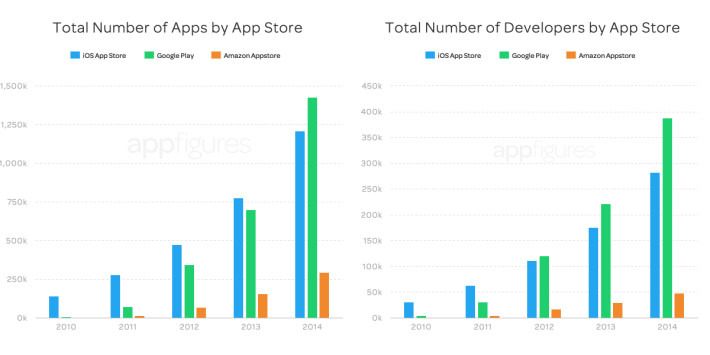
This statistic contains data on the number of apps available for download in leading app stores as of June 2016. As of that month, Android users were able to choose between 2.2 million apps. Apple's App Store remained the second-largest app store with 2 million available apps.

In 2015, the global mobile internet user penetration has exceeded half the world’s population, while the average daily time spent accessing online content from a mobile device, such as a smartphone, a tablet computer or wearable, has reached 3.26 hours daily among youths. Accounting for this popularity is also the growing creation and use applications (shortened to simply apps) – computer programs adapted for mobile use and focused on an extremely wide array of purposes, from gaming to weight loss apps and from mobile messengers to animation software.


Currently, the two largest global platforms for app distribution are Apple’s App Store, which caters to iOS users, and Google Play, belonging to the eponymous company, which is the official app store for the Android OS. 

The fact that mobile apps are relatively easier to create than computer apps, as well as their considerable lower price has translated into a growing industry which produces every year more and more. In fact, it is impossible to know exactly how many apps are there, but, as of November 2015 there were some 1.8 million apps in Google Play alone, 200 thousand more than in July of the same year. The Apple Store, on the other hand, had gone from 800 apps in July 2008 , the month of its launch, to 1.5 million in June 2015. Apple estimates that, by June 2015, apps from the Apple App Store were downloaded a cumulative 100 billion times. However, statistics show that many downloaded apps are not used more than once in the first six months. The most popular Apple App Store category is gaming with about 23 percent of available apps belonging to this category.  


Applications generate revenue in a number of different ways, such as charging users a small amount of money for the use of an app (an average of 1.02 U.S. dollars per app in the Apple Store), charging for access to premium features of an otherwise free app or simply selling ad space. In 2015, Google Play generated an estimated 6 billion U.S. dollars in revenues.